✕
Create a free account to see live performance
SEC rules require us to show performance inside a logged-in account.
Every strategy runs live. Inside, you see every holding, every trade, and every move to cash.
SEC rules require us to show performance inside a logged-in account.
Every strategy runs live. Inside, you see every holding, every trade, and every move to cash.
An AI trading bot is software that uses data and an AI model to decide on trades, place them, or both. Some are plain rule followers with an AI label, and others are true AI agents. Knowing which is which is the first step to judging one.
· AI trading bots come in 3 main types: rule-based bots, machine learning bots, and AI agents built on chatbots.
· Every bot follows the same basic loop: data in, a decision, a risk check, an order, and monitoring.
· Some products use the word "AI" for plain fixed rules. US regulators call this AI-washing.
· AI agents, such as Claude or ChatGPT connected to a broker, can misread instructions or state false facts.
· A legitimate bot trades in your own brokerage account. Sending money to a bot operator is a red flag.
· No AI trading bot can predict the market, and none can guarantee returns.
An AI trading bot is a program that reads market data and makes or carries out trading decisions with little or no human input. The "AI" part means some decisions come from a trained model, not only from fixed rules a person wrote.
In practice, the label covers very different products. A bot that buys when a price crosses a line is not the same as one that learned from millions of data points. Neither is the same as a chatbot placing orders on your instructions.
There are 3 main types of AI trading bots. They differ in where the decisions come from.
A rule-based bot follows fixed instructions, such as "buy when the 50-day average crosses above the 200-day average." There is no learning. Many products sold as AI bots are this type.
A machine learning bot uses a model trained on past data to spot patterns and make predictions. The model, not a person, decides which inputs matter. Markets change, though, so a pattern learned from the past can stop working.
An AI agent is a chatbot, such as Claude or ChatGPT, connected to a brokerage so it can act. You give it instructions in plain language, and it places orders. Robinhood, for example, lets outside AI agents trade in a separate agentic account.
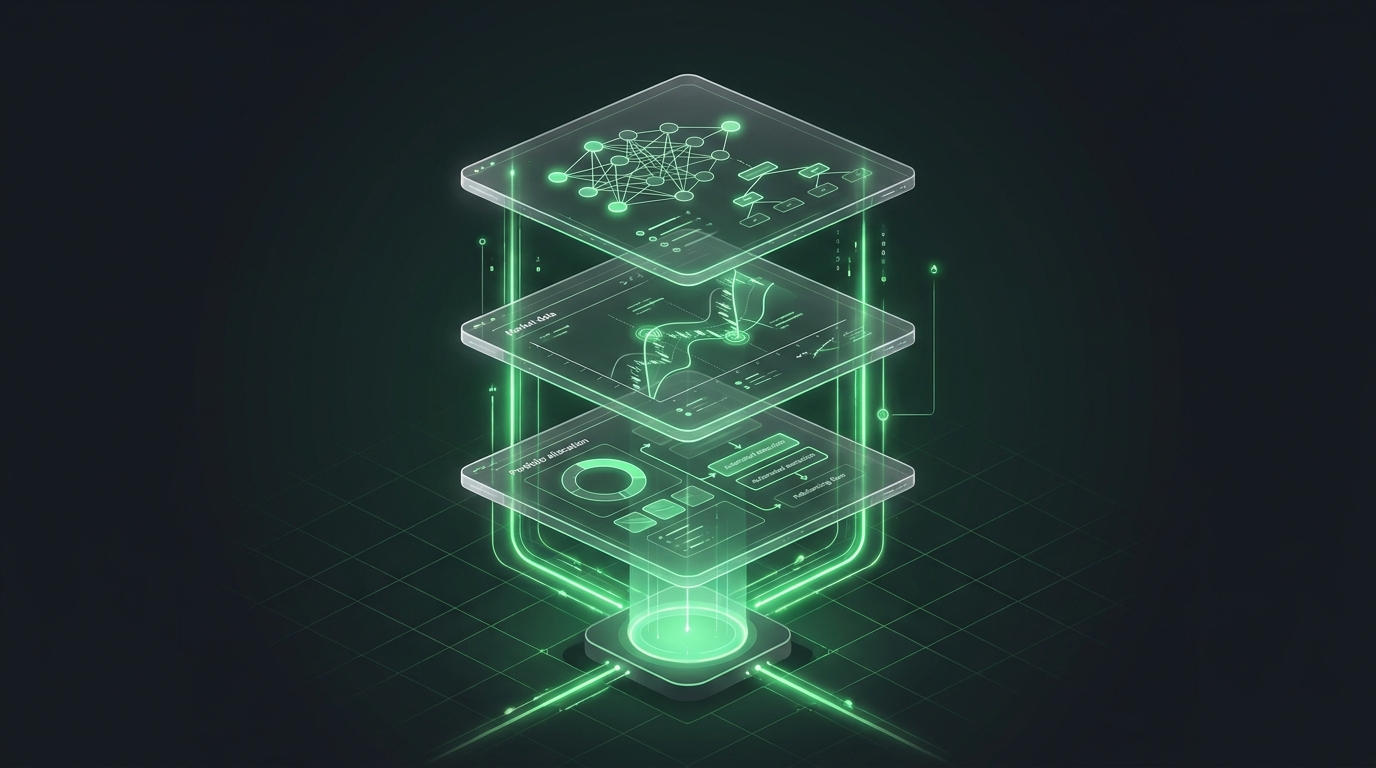
Every AI trading bot runs the same basic loop, whatever its type. Each step is a place where things can go right or wrong.
1. Data in. The bot reads prices, volume, news, or account data.
2. Decision. Rules, a model, or a chatbot decide whether to buy, sell, or wait.
3. Risk check. Limits on trade size, losses, or exposure decide whether the order is allowed.
4. Order out. The bot sends the order to a broker or exchange through a connection called an API, or through MCP for AI agents.
5. Monitoring. The bot tracks fills and positions, then repeats the loop.
An API, or application programming interface, is a way for software to talk to a broker. MCP, the Model Context Protocol, is a newer standard that lets AI apps connect to outside services.
You can tell by asking how its decisions are made and getting a clear answer. US regulators warn about "AI-washing." That is when companies use AI buzzwords to attract investors without the substance.
The SEC, FINRA, and state regulators issued a January 2024 investor alert on this tactic. State regulators joined through NASAA, the North American Securities Administrators Association. It also warns about pitches like "our proprietary AI trading system can't lose."
Ask these questions:
· Is the logic fixed rules, a trained model, or a chatbot?
· What data does it use, and how often?
· Was it tested on data it never saw while being built?
· Who can see or change the rules?
Vague answers like "proprietary AI" are not answers.
An AI trading bot cannot predict the future. It can only act on patterns in past data or on instructions you give it.
AI agents add their own risks.
FINRA is the Financial Industry Regulatory Authority. It lists hallucinations, acting beyond intended scope, and hard-to-trace reasoning as risks of AI agents. A chatbot can also give a different answer to the same question, so the same request can lead to different trades.
For the evidence on whether bots make money, read do AI trading bots actually work? It covers the five ways bots fail in testing.
With a legitimate bot, your money stays in your own brokerage account. The bot gets permission to place trades there, and you can see every order.
Be wary of any bot that asks you to send money to its operator, its own wallet, or a pooled account. That setup removes your control and is a common feature of fraud. The SEC's alert also urges investors to check whether a platform is registered.
Check who runs it, where your money sits, and what controls you keep. This checklist helps.
1. Look up the company and its people on the SEC's adviser search or FINRA BrokerCheck.
2. Confirm the bot trades in your own account at a regulated broker.
3. Ask what type of bot it is: rules, machine learning, or AI agent.
4. Ask how it was tested, and whether any results were tested on unseen data.
5. Find out all costs, including subscription fees and trading costs.
6. Make sure you can pause it or cut its access at any time.
7. Start with a small amount you could afford to lose.
Rules that keep re-fitting to recent data are a warning sign. Read why the best trading models refuse to learn.
Portfolio Lab is a strategy research and simulation tool from alphaAI Capital. It lets you build investment strategies and test them in live markets with virtual money. You can connect it to AI apps like Claude or ChatGPT, so your agent has a strategy's plan to follow.
An AI trading bot is software that uses data and an AI model to decide on trades, place them, or both.
Some follow their rules well, but none can predict the market. Most fail in testing because of overfitting, costs, or changing markets.
Using software to trade your own brokerage account is common. Fraudulent bots that promise guaranteed returns are not. This is not legal advice.
Some tools are free to start. Free does not mean trustworthy, so check who runs the bot and where your money sits.
A bot usually follows code or a trained model. An agent is a chatbot that reads your instructions and acts on them.
They can act as AI agents when connected to a broker that supports it, such as Robinhood. They follow your instructions, not their own strategy.
Watch for guaranteed returns, pressure to act fast, and requests to send money to the bot operator instead of your own broker.
Yes. Bots can make errors, follow bad rules, or trade in fast markets. Only use money you could afford to lose.
Build, test, and deploy your own strategies in Portfolio Lab. Free to start.
Educational & Research Disclosure: The content provided is for informational and educational purposes only and is not intended to constitute investment advice, a recommendation, solicitation, or offer to buy or sell any security. Any discussion of market trends, historical performance, academic research, models, examples, or illustrations is presented solely to explain general financial concepts and does not represent a prediction, guarantee, or assurance of future results. Past performance is not indicative of future results. All investing involves risk, including the possible loss of principal.